Raymond Chua
Hey there and a warm welcome!
Last updated 7 June 2026.
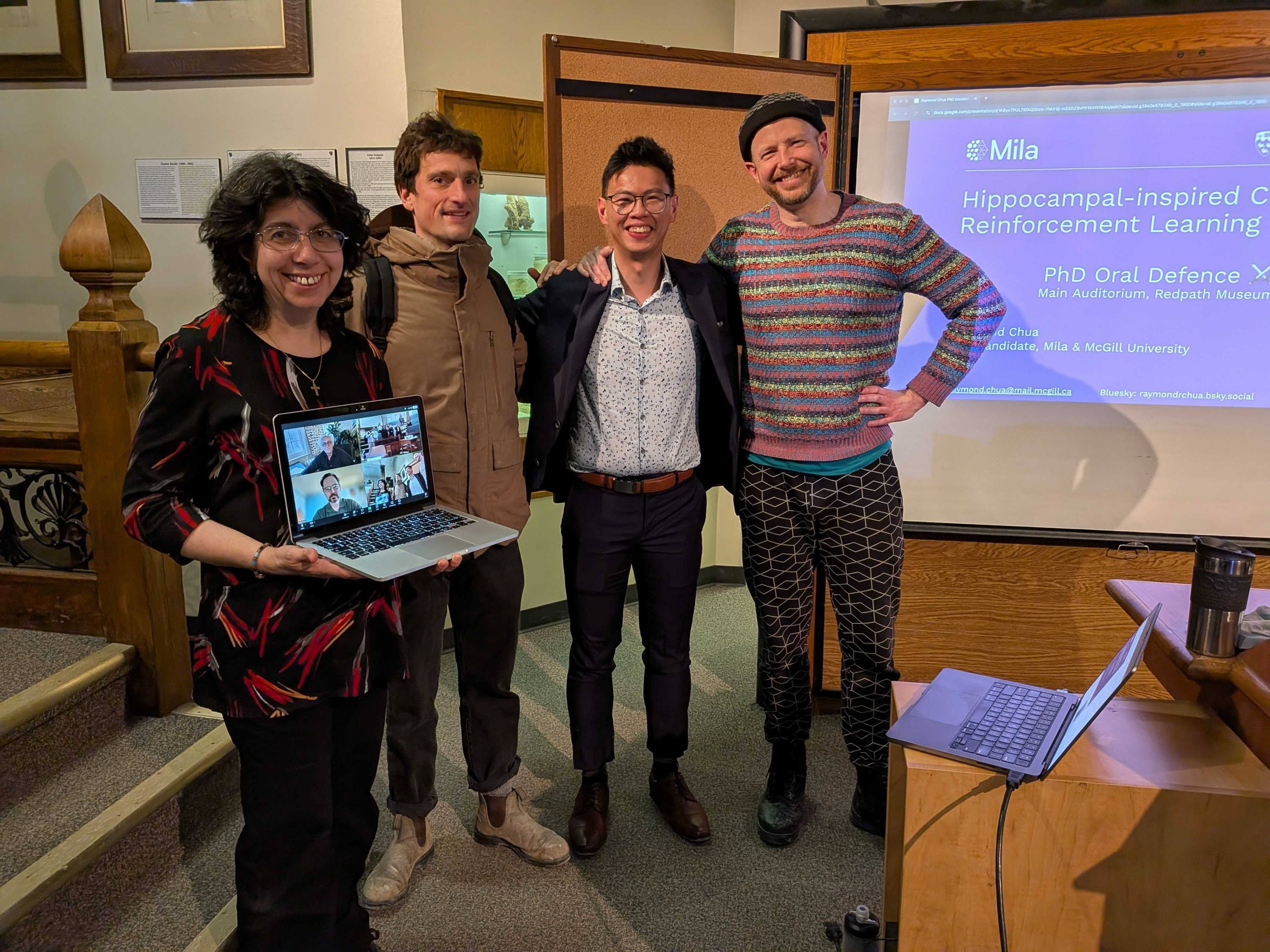
I recently defended my PhD in Computer Science at McGill University, conducted at Mila – Quebec Artificial Intelligence Institute, under the supervision of Doina Precup and Blake Richards. My research bridges reinforcement learning and computational neuroscience, investigating how principles such as predictive representations and memory consolidation can inform the design of adaptive, continually learning AI systems.
My doctoral work addressed the plasticity–stability dilemma in reinforcement learning through structured predictive representations and multi-timescale learning mechanisms, demonstrating how biologically inspired approaches can reduce interference while preserving adaptability.
Building on this foundation, I am increasingly interested in mechanistic interpretability — using tools inspired by neuroscience, such as representation similarity analysis and cross-attention probing, to understand how predictive representations (e.g., successor features) encode and transform information over time. I am particularly motivated by questions at the intersection of continual learning, foundation models, and embodied decision-making systems.
Beyond research, I’m passionate about improving AI capabilities through academic–industry partnerships, where I mentor students from McGill, UdeM, and Mila as they tackle real-world challenges with companies seeking to integrate machine learning into their products and pipelines. During my free time, I enjoy pushing both my intellectual and physical abilities through triathlon, which continues to teach me about endurance, balance, and growth.
news
| Apr 30, 2026 | Our latest work (together with Doina Precup and Blake Richards) on continual reinforcement learning and biologically inspired memory systems, “Balancing Plasticity and Stability with Fast and Slow Successor Features,” has been accepted to International Conference on Machine Learning (ICML) 2026. See you in Seoul, Korea! 🇰🇷🧠🚀 |
|---|---|
| Apr 23, 2026 | Gave an invited research talk at New York University in Marcelo Mattar’s lab on continual reinforcement learning, predictive representations, and biologically inspired learning systems. |
| Apr 21, 2026 | Visited the Zuckerman Institute at Columbia University to discuss recent work on continual reinforcement learning and computational neuroscience. |
| Mar 24, 2026 | Participated in the Foundation Models Winter School in Amsterdam, exploring recent advances in foundation models. Hosted by Ellis unit Amsterdam 🇳🇱 |
| Feb 20, 2026 | Excited to share that I have successfully defended my PhD thesis! Thank you to my examiners, Prof. Mark Crowley (University of Waterloo), Prof. Ross Otto (McGill) and my advisors Blake and Doina! |
selected publications
- NeurIPSDeep RL Needs Deep Behavior Analysis: Exploring Implicit Planning by Model-Free Agents in Open-Ended EnvironmentsProceedings of the 39th Conference on Neural Information Processing Systems (NeurIPS), 2025This is my first collaboration work with members of Prof. Kanaka Rajan’s lab. Riley and Ryan are first authors, and Prof. Kanaka Rajan is the corresponding author.